Raising a Boy When You've Never Been One
- Megan Neff

- Apr 21
- 4 min read
Updated: Jul 25
There's a version of the gay mom narrative that gets told a lot. It's tender and hard-won and real: the logistics, the legal hoops, the joy of finally holding your child. It’s the forms that don't have a box for your family, the explaining, the advocacy. The quiet pride of building a family that didn’t have a template waiting for it.
I have lived that story, and I love it.
But there's a chapter that comes after the baby arrives that nobody really briefs you on:
What happens when your child is a gender you’ve never been?
I'm a woman. My wife is a woman. We both have sisters. Between us, we have exactly zero lived experience being a boy. And I did not fully understand what that would mean until I was already deep into raising one.
It’s not that I thought gender didn’t matter. It’s that I assumed love and intention would smooth out the differences. And in many ways, they do. But love doesn’t magically hand you firsthand memory. It doesn’t give you muscle memory for boyhood.
There is a gap. And naming it feels more honest than pretending it isn’t there.

JOIN GAY MOMS CLUB
Gay Moms Club is a welcoming online community for LGBTQ+ moms who want real connection, honest conversations, and friendships that fit into real life.
You shouldn’t have to explain your family before you can make a friend.
The Things I Had to Learn on the Fly
✨ Bodily stuff is its own adventure.
Historically, I am a person who looks away. Who asks someone else to handle the splinter. Who has a whole system for getting through doctor's appointments without passing out. None of that prepared me for the sheer enthusiasm my son has about his own anatomy.
I have had to learn to discuss it matter-of-factly, even though everything in me wanted to change the subject. I have had to be the parent who names things correctly and doesn't flinch, even when I was, privately, flinching. Neutrality, I’ve learned, is a discipline.
✨ The social architecture of boy-world is foreign to me.
I was a girl. I had girl friends. I know how girls navigate friendship: the alliances, the coldness, the repair. Boy friendships, at least at age six, seem to operate on entirely different logic. Physical play that looks like aggression but isn't. Insults as affection. A whole emotional language spoken in roughhousing and running.
I have had to study it like a foreign culture, because I was never a citizen.
✨ I can't tell him what it felt like to be a boy.
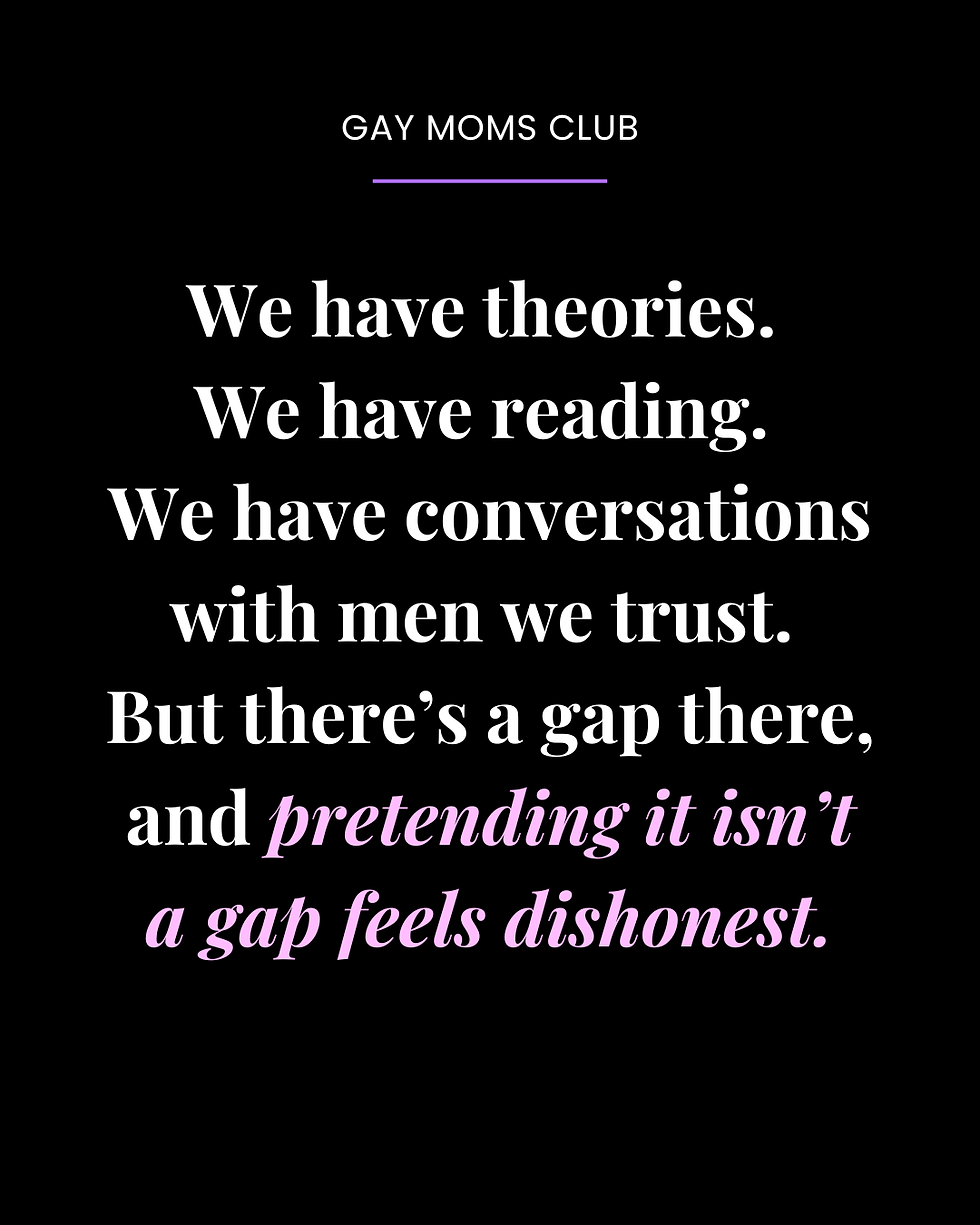
When my son is struggling, I can tell him about my own childhood. But I cannot tell him about the particular loneliness of trying not to cry in front of other boys. I cannot tell him what it felt like to discover masculinity and be unsure how much of it to claim. My wife can't either. We have theories. We have reading. We have conversations with men we trust. But there's a gap there and pretending it isn't a gap feels dishonest.
✨ Representation matters in ways I underestimated.
I spend a lot of energy making sure my son sees families like ours in books, in stories, in the world. I've done that since before he could talk. What I didn't anticipate was how much I would also need to curate his exposure to healthy male figures. Not to replace anything, but to supplement what we can offer.
At some point, I sat down and actually took stock of the men in my life. Not abstractly, but concretely: who are they, what do they model, would I want my son to grow up and be something like them? It was a more useful exercise than any parenting book I'd read.
Some people made the list easily. Others I had to think harder about than I expected.
We had to actively build that for him because it wasn't going to happen automatically.
What I Wish Someone Had Told Me
Nobody in the parenting groups I found online talked about this. The conversation was and still is so focused on the journey to parenthood, the legal structures, the chosen family, the identity work, that the gender-of-your-child question often gets skipped over.
As if once the baby arrives, the difficulty is the same regardless.
It's not the same. It's not harder, necessarily. But it's different.
You will not know what you don't know until you're in it. The boys who become your son's friends will teach you things. Your son will teach you things. You will find men worth admiring and bring them close. You will fumble. You will over-explain and under-explain and find the middle eventually.
You will also discover that "I don't know exactly what that feels like, but I want to understand", spoken with genuine curiosity and no defensiveness, lands with a child as safety. That sentence alone has carried us further than any book I’ve read or conversation I’ve sought out.
I am figuring this out as I go. Every gay mom I know is figuring this out as she goes.
We are, all of us, learning.
JOIN GAY MOMS CLUB
Gay Moms Club is a welcoming online community for LGBTQ+ moms who want real connection, honest conversations, and friendships that fit into real life.
You shouldn’t have to explain your family before you can make a friend.


Comments